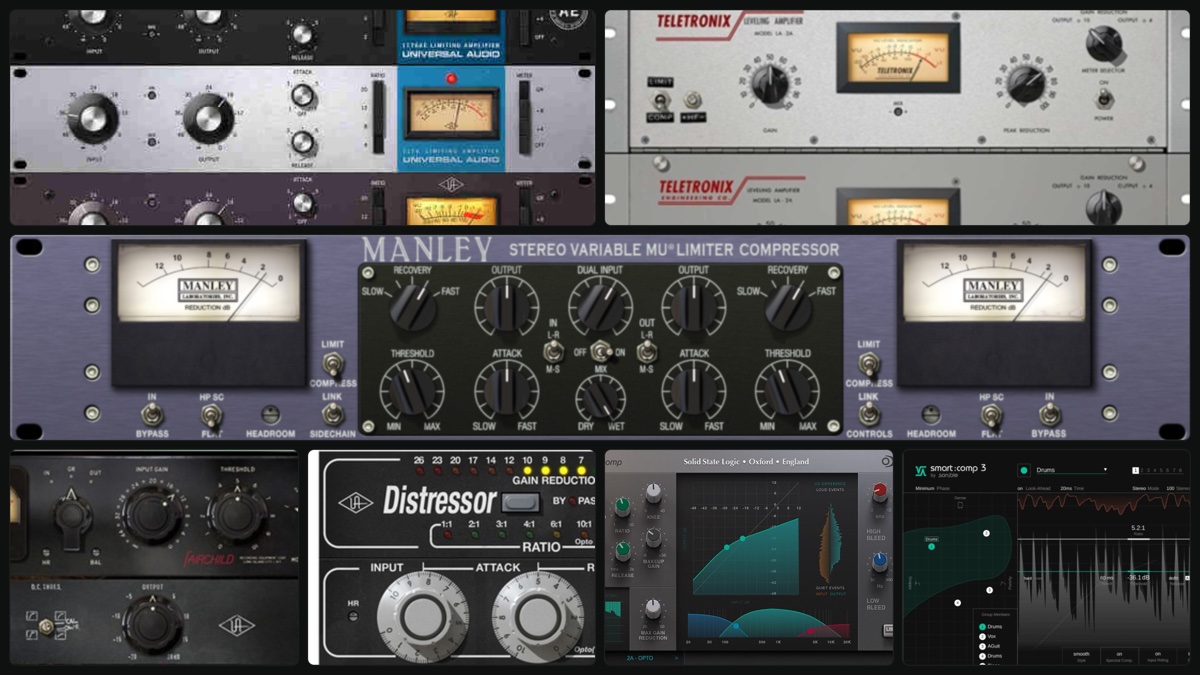
Almost every compressor plugin copies one of four kinds of analogue hardware: VCA, optical, FET or vari-mu. They all turn loud parts down, but each one reacts at a different speed and adds a different amount of colour. That’s why an 1176 can sound right on a shouted vocal and too aggressive across a whole mix.
This guide explains how each type works, what it sounds like, which jobs it suits, and the plugins on Plugin Boutique that copy the classic units. If you’re new to threshold, ratio, attack and release, start with our Compression for Beginners guide and come back.
This article draws on Become a Competent Music Producer in 365 Days by Sam George, whose compression unit covers the four types. You can buy it from the independent bookshop Backstory.
Compressor Types at a Glance
| Type | Speed | Sound | Use it on | Classic unit |
|---|---|---|---|---|
| VCA | Very fast, precise | Clean | Drums, groups, mix bus | SSL bus compressor, API |
| Optical | Smooth, a little slow | Gentle, rounded | Vocals, bass, keys | Teletronix LA-2A |
| FET | Very fast | Coloured, punchy | Vocals, guitars, drums | UA 1176 |
| Vari-mu | Smooth | Thick, warm | Mix bus, mastering | Fairchild 670, Manley Vari-Mu |
VCA Compressors: Clean and Precise
VCA stands for voltage controlled amplifier. Inside, the signal splits in two. One path measures the level and decides how much to turn it down. The other path is the audio you hear. Because the measuring side is separate, a VCA compressor can be set very accurately and does the same thing every time.
VCA compressors react very quickly and add little colour. That makes them good at holding drums in place without changing their tone, and at gluing a group of tracks or a whole mix together. The compressors on SSL consoles and the API units are VCA designs, and the SSL bus compressor is one of the most copied mix-bus compressors.
Use a VCA when you want control and don’t want to hear the compressor. On a snare, a slow attack (around 30 ms) lets the hit through before the compressor starts working, and a fast release lets it recover before the next hit.
Optical Compressors: Smooth on Vocals
An optical compressor uses light. The incoming audio drives a small light, and the brighter it gets, the more a light-sensitive resistor turns the signal down. The light and the resistor take a moment to respond, so an optical compressor never grabs instantly.
The timing isn’t fixed either. There’s often a short delay before it starts working. Hit it harder and it lets go faster at first, then more and more slowly as it recovers. The result is smooth compression that doesn’t jump about, which suits vocals, bass and other melodic parts.
The classic optical units are the Teletronix LA-2A and LA-3A. The LA-2A has no attack or release controls at all: you set Peak Reduction for how much it compresses and Gain for the output level. Two knobs makes it one of the easiest compressors to learn, because the unit chooses the timing for you.
FET Compressors: Fast with Character
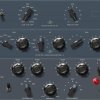
FET stands for field effect transistor. The best-known FET compressor is the Universal Audio 1176, which has been on records since the late 1960s and is still copied by almost every plugin maker.
FET compressors are very fast and add colour, especially when pushed. Most have no threshold control. On an 1176 you turn up Input to drive more signal into the compressor, which means more compression, and use Output to set the level coming out. Ratio buttons choose how hard it squashes.
That speed and edge suit vocals that need to cut through, electric guitars, and drums, whether on single tracks or a drum group. FET compressors aren’t usually the first choice for the mix bus, where their colour and fast grab can make a whole mix sound tense.
Vari-Mu Compressors: Thick Mix-Bus Glue
Variable mu (vari-mu) compressors use valves, which Americans call tubes. As the incoming signal gets louder, the valves amplify less, so the level comes down. There’s usually no ratio knob, because the compression gets stronger the harder you drive it.
The valves add a gentle distortion that most people hear as warmth. Vari-mu compressors can also take a lot of gain reduction before they sound obviously squashed, and they handle sharp transients smoothly rather than clamping down on them. That’s why they’re mostly used on the mix bus and in mastering, to pull a mix together.
The famous examples are the Fairchild 660 and 670, heard on records by The Beatles and Pink Floyd, and the Manley Variable Mu, Manley’s flagship compressor since 1994.
Which Compressor Type to Use When
These are starting points, not rules. Plenty of mixers use an LA-2A on drums or an 1176 on bass.
- Lead vocal: FET to catch the jumpy peaks, or optical for smooth, even control. For a vocal with a big difference between quiet and loud lines, use both (see below).
- Kick, snare and drum group: VCA for clean punch, FET for something more aggressive.
- Bass: optical for an even level that doesn’t sound compressed, FET if it needs to growl.
- Acoustic guitar, piano and keys: optical.
- Electric guitar: FET.
- Mix bus: VCA for clean glue, vari-mu for warmth. Keep it to a dB or two of gain reduction.
Stacking two types on a vocal
Squeezing 10 dB out of a vocal with one compressor usually sounds unnatural. Two compressors doing 3 to 6 dB each sounds far better, and you can use a different type for each job. Put a FET first, set to grab only the loudest peaks. Follow it with an optical compressor that evens out the rest gently. The 1176 into an LA-2A is the classic version of this chain, but two stock compressors set the same way will teach you the idea.
Kick and bass together
Low end needs a steady level, or the track feels thin each time the bass drops. Sending kick and bass to one group and compressing them together gently helps them sit as one part. Aim for 2 to 3 dB of gain reduction to start. A VCA is the usual choice here because it stays clean.
Do You Need All Four Types?
No. The compressor that came with your DAW is enough to learn on, and you should stick with one until you can hear what attack and release are doing. Different types only help once you can hear the differences between them.
When you compare compressors, match the levels. A compressor can make a sound louder overall, and louder nearly always sounds better for a few seconds. Turn the output down until switching the compressor on and off makes no difference to the overall volume, then judge the sound. A VU meter helps: watch where the needle sits through the body of the sound, not on the peaks.
Many DAW compressors already have modes or styles that imitate these types. Look for names like “Opto”, “FET”, “VCA”, “Vintage” or “Bus” in the menu before buying anything.
The Best Compressor Plugins for Each Type
The prices below are normal prices. Universal Audio’s compressors often go on sale for far less, so check our Black Friday plugin deals page before you buy.
SSL Native X-Comp: VCA, and the others too
X-Comp is a stereo compressor from Solid State Logic. Rather than copying one unit, it gives you enough control to imitate a range of designs, including optical, FET and vari-mu styles, and it can go from invisible mastering control to brick-wall limiting. It also has a sidechain for ducking and de-essing. It covers more types than any other plugin here. Normal price: $99.
Teletronix LA-2A Leveler Collection: optical
LA-2A Leveler Collection from Universal Audio models three units: the late-1960s Silver, the Gray, and the rare early-1960s LA-2. The Silver has the fastest timing and copes with drums as well as vocals. The LA-2 is the slowest and suits slow vocals. All three have the same two-knob layout. Normal price: $149.
1176 Classic Limiter Collection: FET
1176 Classic Limiter Collection gives you three versions of the 1176: the original Rev A “Bluestripe”, the Rev E “Blackface” and the gentler 1176AE. It has a Mix knob for parallel compression. Our 1176 Classic Limiter Collection page has more detail. Normal price: $199.
Fairchild Tube Limiter Collection: vari-mu
Fairchild Tube Limiter Collection models the Fairchild 670 (stereo) and 660 (mono), including their valve amplifier and transformer stages. It adds a Wet/Dry control, a sidechain filter so the kick doesn’t drive the compression on a drum group, and a Headroom control that sets how much grit it adds. Normal price: $149.
Manley Vari-Mu: vari-mu for the mix bus
Manley Variable Mu, also from Universal Audio, is the cleaner of the two vari-mu plugins here and is built mainly for the mix bus and mastering. It has mid/side mode, a high-pass sidechain filter to stop the low end pumping, and a Dry/Wet control. Normal price: $149.
Empirical Labs EL8 Distressor: the modern all-rounder
EL8 Distressor doesn’t fit neatly into the four types. It’s a modern design with ratios from 1:1 to “Nuke” and two distortion modes, so it can be clean, warm or wrecked. It’s popular on drums, room mics, vocals and bass. See our EL8 Distressor page. Normal price: $199.
sonible smart:comp 3: the assisted option
smart:comp 3 doesn’t copy any hardware. It analyses the incoming sound and shows a range of settings that suit it, which cuts out a lot of trial and error while you’re learning what compression should sound like. Normal price: $129.
Compressor Types FAQs
What’s the difference between VCA and FET compressors?
Both are fast. A VCA is clean and precise and has a threshold control. A FET adds more colour and is driven with an Input knob instead of a threshold. VCAs suit drums and the mix bus. FETs suit vocals, guitars and drums.
Which compressor type is best for vocals?
Optical for smooth, even control, FET when the vocal needs to cut through. Many engineers use a FET into an optical, each doing a few dB.
Which compressor type is best for the mix bus?
VCA or vari-mu, with gentle settings. The SSL bus compressor (VCA) is one of the most copied. Vari-mu adds more warmth.
Is an 1176 a limiter or a compressor?
Both. It’s sold as a limiting amplifier, but at its lower ratios (4:1 and 8:1) it works as a compressor. A ratio of 10:1 or more is usually counted as limiting.
Why does the LA-2A have no attack or release knobs?
Its optical cell sets the timing, and it changes with how hard you hit it. That’s a large part of why it sounds smooth.
Do I need hardware emulations to get a good mix?
No. A stock compressor will do the job on every track. Learn one compressor first, then add other types when you can hear what they’d do differently.
Sources
- Sam George, Become a Competent Music Producer in 365 Days (Routledge, 2023): Unit 4, Days 6 to 9 (the four analogue compressor types), Day 10 (learning on one compressor), Day 14 (matching levels), Day 16 (stacking compressors) and Day 17 (compressing low end).
- Plugin Boutique product pages for SSL Native X-Comp, Teletronix LA-2A Leveler Collection, 1176 Classic Limiter Collection, Fairchild Tube Limiter Collection, Manley Vari-Mu, EL8 Distressor and smart:comp 3 (31 October 2026).