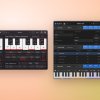
See and hear any chord, name the keys you press, find the chords in a key, or transpose a song
Click or tap the keys you are playing, or play them on a MIDI keyboard. The lowest key counts as the bass note.
Playing notes here doesn’t change the chord.
Piano chord chart: the notes in every common chord
Each cell lists the notes from the root up. Select a chord to see it on the keyboard and hear it.
This piano chord finder shows any chord on a keyboard and plays it with a real piano sound. It can also work backwards: press the keys you have under your fingers and it tells you the chord’s name. Everything runs in your browser, so there’s nothing to sign up for or install.
How to Use the Piano Chord Finder
Name my chord
Click or tap the keys you’re playing, or play them on a MIDI keyboard. The name appears as soon as there are enough notes, and the lowest key is treated as the bass note. Play E, G and C with E at the bottom and you get C/E, which is C major in first inversion.
Plenty of note groups have more than one correct name. C, E, G and A can be C6 or Am7 played over C, so the finder shows the most likely name first and lists the others under “It could also be”. Chords with the 5th left out are still recognised, because that’s how most pianists play 7ths and 9ths. For note groups that aren’t one of the 27 standard chord types, you get a built-up name such as C7(no3) or Cmaj7(♯11), the same way music software names them.
Find a chord
Choose a root note and a chord type. The keyboard shows the notes, and the readout gives the note names and the formula, for example 1 – ♭3 – 5 for a minor chord. From there you can:
- pick an inversion to hear the same chord with a different note at the bottom
- move the whole chord up or down a semitone
- copy a link that opens this exact chord, which is handy for sending to a bandmate or a student
Under the keyboard, “Keys that contain these notes” lists every major key (with its relative minor) whose scale has all the notes of the chord.
Chords in a key
Choose a key and a scale (major, natural minor or harmonic minor) to see the seven chords that belong to it, with their Roman numerals. Switch between triads and 7th chords. Tap a chord to hear it, or Shift-click it to open it in the chord finder with its inversions.
Transpose
Paste the chords of a song, or a whole chord chart with lyrics, and pick how many semitones to move it. Only the chord lines change; lyrics are left exactly as they were, and the chords stay lined up above the same words. “Spell with” lets you force sharps or flats if a key reads more easily one way.
Playing Chords on a MIDI Keyboard
If you have a USB or Bluetooth MIDI keyboard, click “Connect MIDI keyboard” above the readout and allow MIDI access when your browser asks. The keys light up while you hold them, the sustain pedal works, and harder playing sounds louder. In “Name my chord”, the chord you play is named straight away and the name stays on screen after you let go.
MIDI works in Chrome, Edge and Firefox on a computer. Safari and iPhones don’t support it, but you can still click or tap the keys.
How Piano Chords Are Built
Every chord is a stack of intervals counted up from the root, and the easiest way to count an interval on a piano is in semitones: one semitone is the next key along, black or white.
- Major: root, up 4 semitones, up 3 more. C, E, G.
- Minor: root, up 3, up 4. C, E♭, G.
- Diminished: root, up 3, up 3. C, E♭, G♭.
- Augmented: root, up 4, up 4. C, E, G♯.
Seventh chords add one more note on top. A dominant 7th (C7) adds the note 10 semitones above the root, B♭. A major 7th (Cmaj7) adds the note 11 semitones above, B. That one-key difference is why C7 sounds restless and wants to move on, while Cmaj7 sounds settled.
The chart at the bottom of the tool lists the notes of 9 common chord types for all 12 roots. Click any box to see it on the keyboard and hear it.
Why does the finder show E♯ or a double sharp?
Each note in a chord is named after its place in the chord, not after the nearest white key. The 3rd of C♯ major has to be some kind of E, so it’s E♯, even though you play it on the F key. In C♯ augmented the 5th has to be some kind of G, so it’s G𝄪 (G double sharp), played on the A key. The keyboard always lights the keys you actually press, and for double sharps and flats the readout adds a “Same keys as” line with the everyday note names.
Piano Chord Questions
What notes are in a C major chord?
C, E and G. The same shape moved to any other root gives you that root’s major chord: G major is G, B, D and F major is F, A, C.
How can I tell what chord I’m playing?
Open “Name my chord” and press the same keys on the on-screen piano or on a MIDI keyboard. If you only know the notes from sheet music, enter them in any octave. The finder works out the name from which notes are there and which is lowest.
What is a slash chord, such as C/G?
The letter before the slash is the chord and the letter after it is the bass note. C/G is a C major chord with G as the lowest note. When the bass note belongs to the chord, as G does here, a slash chord is just an inversion.
What is a chord inversion?
An inversion keeps the same notes but puts a different one at the bottom. C major in root position is C, E, G. First inversion is E, G, C. Second inversion is G, C, E. Pianists use inversions to move between chords without jumping their hands around.
Which chords are in the key of C major?
C, Dm, Em, F, G, Am and Bdim. As 7th chords they are Cmaj7, Dm7, Em7, Fmaj7, G7, Am7 and Bm7♭5. “Chords in a key” shows the same list for every other key.
Keep Going
- Build progressions from these chords on the free virtual piano with chord progressions and MIDI recording.
- How to use the virtual piano: chords, loops, recording and export.
- Play ready-made loops: lofi chord progressions and techno chord progressions.
- If you keep coming back to the same few chords, read Breaking the 3 Chord Habit.
- For moving a song into a new key, see The Art of Key Changes in Music.